
Love shouldn't feel like survival.
But for a lot of smart, capable people- it does.

Love shouldn't feel like survival.
But for a lot of smart, capable people- it does.
The Attachment Revolution is a space for building something steadier.
Not by trying harder.
Not by saying it perfectly.
But by becoming someone who doesn’t collapse when connection gets tense.
When you feel steadier, your relationships do too.
Attachment (noun):
The biological and emotional imperative to move toward closeness with another human being.
Revolution (noun):
A fundamental transformation in the way something operates.
"The Disconnect".
You know those moments when you're trying to stay calm… open… connected —
and suddenly something inside you snaps.

You shut down. Or lash out.
You might go numb, overexplain, or disappear into your head.
Later you think,
Why did I react like that? That wasn’t even a big deal.
It’s not a communication issue.
It’s not immaturity.
It’s not you being “too much.”
It’s your body protecting you.
The Disconnect happens when your need for closeness runs into the rules you learned about love. Somewhere along the way, you absorbed messages like:
don’t show too much,
don’t need too much,
don’t be too much.
So when connection feels uncertain, your system pulls you into protection.
That’s The Disconnect.
When we don’t understand what’s happening, we tend to blame ourselves. Or our partners.
Or the entire relationship.
We try harder.
We numb more.
We build resentment.
But when you can recognize the breach for what it actually is —
a protective response, not a character flaw —
you stop fighting yourself.
And everything starts to shift.

The Process
The Disconnect is where most people get stuck — caught between the moment it happens and not knowing how to come back from it.
Together we move through it. Not by managing the moment better, but by building the capacity to reach towards connection even when it gets hard.
Inside this work, we focus on:
Recognizing the disconnect for what it is — a pattern with a logic, not a flaw
Turning the lens inward: understanding the vulnerability underneath your reaction, owning your part without self-blame, and reaching toward the other person from a grounded place rather than a reactive one
Becoming Responsive & Reachable — not just saying the right thing, but being present enough that repair actually lands
This work is for people in relationships, people doing this work solo while their partner isn’t yet engaged, and people between relationships who don’t want to carry the same patterns forward.
You begin with what’s in your control. One person starts the work. That is not the same as one person doing all of it.

MEET psychologist and coach
hey, I'm Dr. Rachel Orleck
I work with people who are done pretending everything’s fine. You’re showing up, doing the work, holding it together — but inside, something feels off. Disconnected. Like no matter how hard you try, it keeps looping back to the same fight, the same silence, the same ache.
That’s where I come in.
With a doctorate in clinical psychology, certification in Emotionally Focused Therapy (EFT), and over 12 years of experience helping people interrupt the patterns driving their relationships, I bring clinical depth into a coaching space that meets you in real life — not just in the therapy hour.
This isn’t about reacting less because you’re “too much.” It’s about understanding what’s actually driving the disconnect — and building the capacity to respond differently.
12+ years helping individuals and couples move from stuck to something steadier
EFT-certified — clinical depth delivered in a coaching space where change can move efficiently
Direct, grounded guidance that gets to what matters — without blame, without shame, without making either person the villain
What Actually Shifts a Relationship
It's not just better communication.
It's a different understanding of what's actually driving the disconnect.
Most of us were taught to fix relationships by managing our words, our timing, our tone. But underneath all of that is something simpler: a system that doesn't feel safe enough to stay open. When that changes — when you can stay present instead of protective, and come back after a disconnect instead of building walls — the relationship changes too. Not because you performed better. Because you actually felt safer.
Inside this work, we focus on:
Recognizing the pattern in real time — before the disconnect becomes a rupture
Understanding what's driving your reaction underneath the surface, and what's driving your partner's too
Emotional responsibility that builds connection instead of resentment
Repair that actually lands — not just words said, but presence felt
Ready to go deeper?
Here's How to Start.
Join the waitlist
The Attachment Revolution Membership is where you learn how to repair the Connection Breach — so you can move out of survival mode and into relationships that feel steadier, safer, and more connected.
Most of us weren’t taught how to feel secure in love. We were taught to manage, adapt, and cope.
This is where you build something different — starting with your nervous system, and expanding outward into how you show up with the people you care about.
The podcast is where we start. The deeper work happens in a container where your specific patterns are the curriculum.
When Love Feels Like Too Much -
Private Audio Series
Five short episodes. A companion workbook. Nervous system resets you can actually use in the moment.
This is the guided version of the work — where we move from understanding the cycle to interrupting it.
Private Coaching
One focused call per month. Unlimited Voxer and email support Monday–Thursday. High-touch, individualized work for people ready to interrupt the pattern in real time — not just understand it.
Available for individuals and couples. Spots are limited.
Coaching for Real Relationships
It's about healing what's underneath.
You’re stuck in the same fight.
Or you're not fighting at all - but something feels...off.
More like coworkers than partners—you know something has to change.
This isn't surface level coaching. It’s rooted in attachment science and nervous system safety, so you can stop spinning in the same painful patterns — and actually start feeling close again.
Because you don’t keep arguing because you’re bad at love. You keep arguing because your nervous system doesn’t feel safe — and your attachment instincts are protecting you the only way they know how.
In our work, we slow it all down. Create safety. Build connection—without walking on eggshells, shrinking, or faking.
Twice a month. Between-session support. Deep clarity. Real momentum.
SERVICE 03
Your Paragraph text goes Lorem ipsum dolor sit amet, consectetur adipisicing elit. Autem dolore, alias, numquam enim ab voluptate id quam harum ducimus cupiditate similique quisquam et deserunt, recusandae. here
What Listeners & Clients Are Saying
Real stories from people shifting the cycle — one episode, one insight at a time.
My partner just came up to me after listening to your latest episode. She finally had the language to talk about a minor argument we had — and we ended up having a short conversation. I understand her better now. Thank you.
⭐⭐⭐⭐⭐
After listening to your podcast and speaking with you, I finally understand more about my wife’s trauma — and what she actually needs from me.
I just listened to your podcast for the first time (‘Loving Someone Who’s Been Hurt’), and it brought me to tears. So healing. Thank you.
⭐⭐⭐⭐⭐
Podcast Listener
Client
Podcast Listener
What Listeners & Clients Are Saying
REAL STORIES FROM PEOPLE SHIFTING THE CYCLE — ONE EPISODE, ONE INSIGHT AT A TIME.
My partner just came up to me after listening to your latest episode. She finally had the language to talk about a minor argument we had — and we ended up having a short. I understand her better now. Thank you.
⭐⭐⭐⭐⭐
Podcast Listener
After listening to your podcast and speaking with you, I finally understand more about my wife’s trauma — and what she actually needs from me.
Client
I just listened to your podcast for the first time (‘Loving Someone Who’s Been Hurt’), and it brought me to tears. So healing. Thank you.
⭐⭐⭐⭐⭐
Podcast Listener
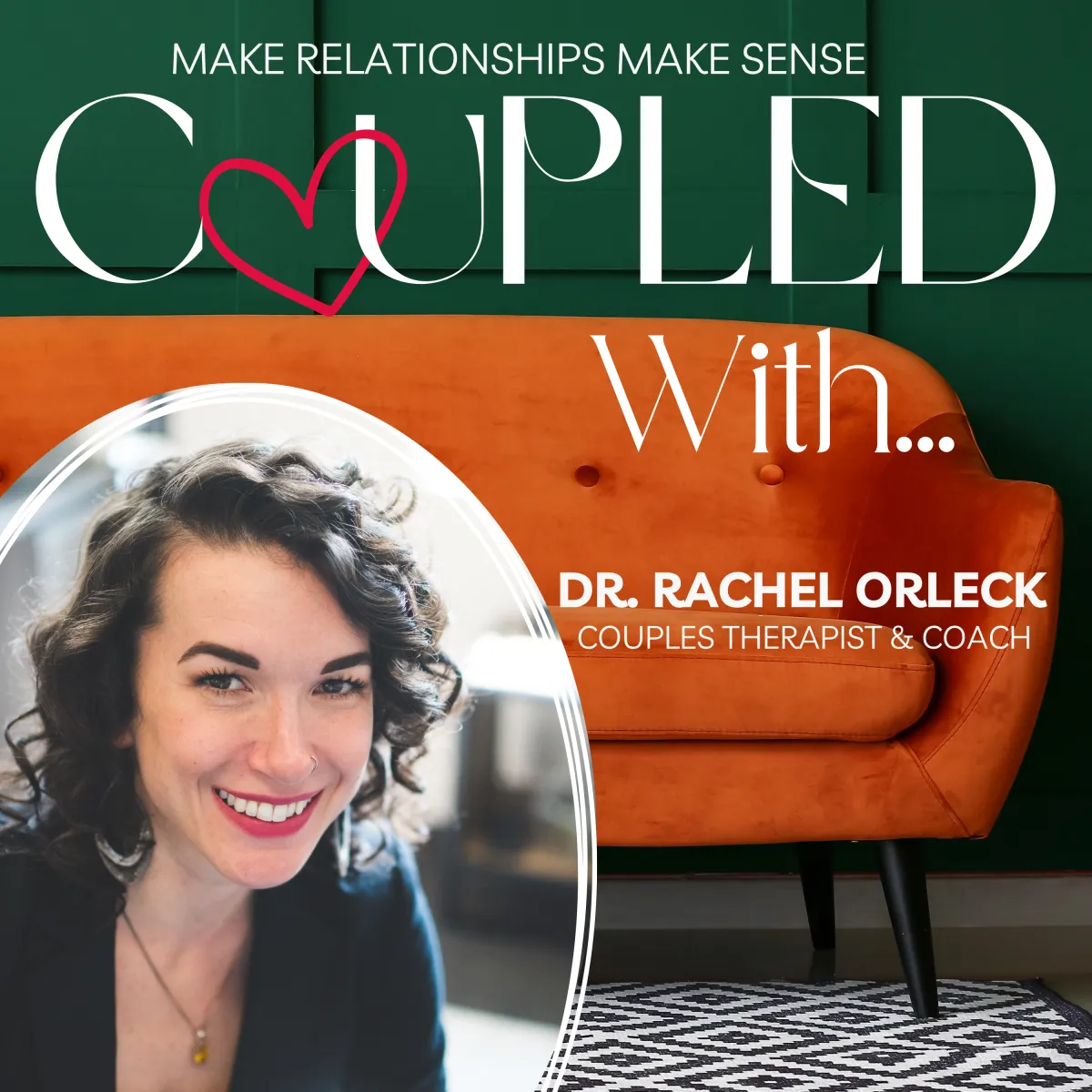
The podcast that says what your therapist
wants to, but can’t.


Coupled With… is where thoughtful, self-aware people come to understand why love can still feel so hard — and what actually helps.
Hosted by Dr. Rachel Orleck, each short, steady episode helps you untangle painful patterns, understand what’s driving the disconnect, and find your way back to connection without losing yourself.
This isn’t just about better communication. It’s about building safety — in your relationship and in the way you show up. And safety changes how everything feels.
Start Here.
Love isn’t the problem.
Survival-mode is.
You need clarity before communication.
You keep replaying arguments. Your partner shuts down and you panic. You overfunction and secretly feel resentful. It’s not because you don’t know what to say. It’s that your nervous system has shifted into protection — and no amount of better wording fixes that.
This free 10-minute training walks you through why love can start to feel overwhelming — and gives you a simple reset you can use the next time conflict begins to escalate.
Watch the free 10-minute training: “Why Love Feels Like Too Much.”
don't miss out on updates
THE LOVE + LIFE NEWSLETTER
Thoughtful relationship insights and practical tools — delivered weekly. You don’t need to be scrolling late at night trying to figure out why something feels off. This is where we slow it down, make sense of what’s happening underneath, and build the kind of safety that actually shifts things.
You’ll receive:
New podcast episodes
Clear, grounded guidance on love, attachment, and relational repair
Early access to new resources and trainings
A relationship revolution starts with you.



View our Privacy Policy, Terms and Conditions, Cookie Policy, Disclaimer, DMCA Policy here. ©2026. All Rights Reserved.